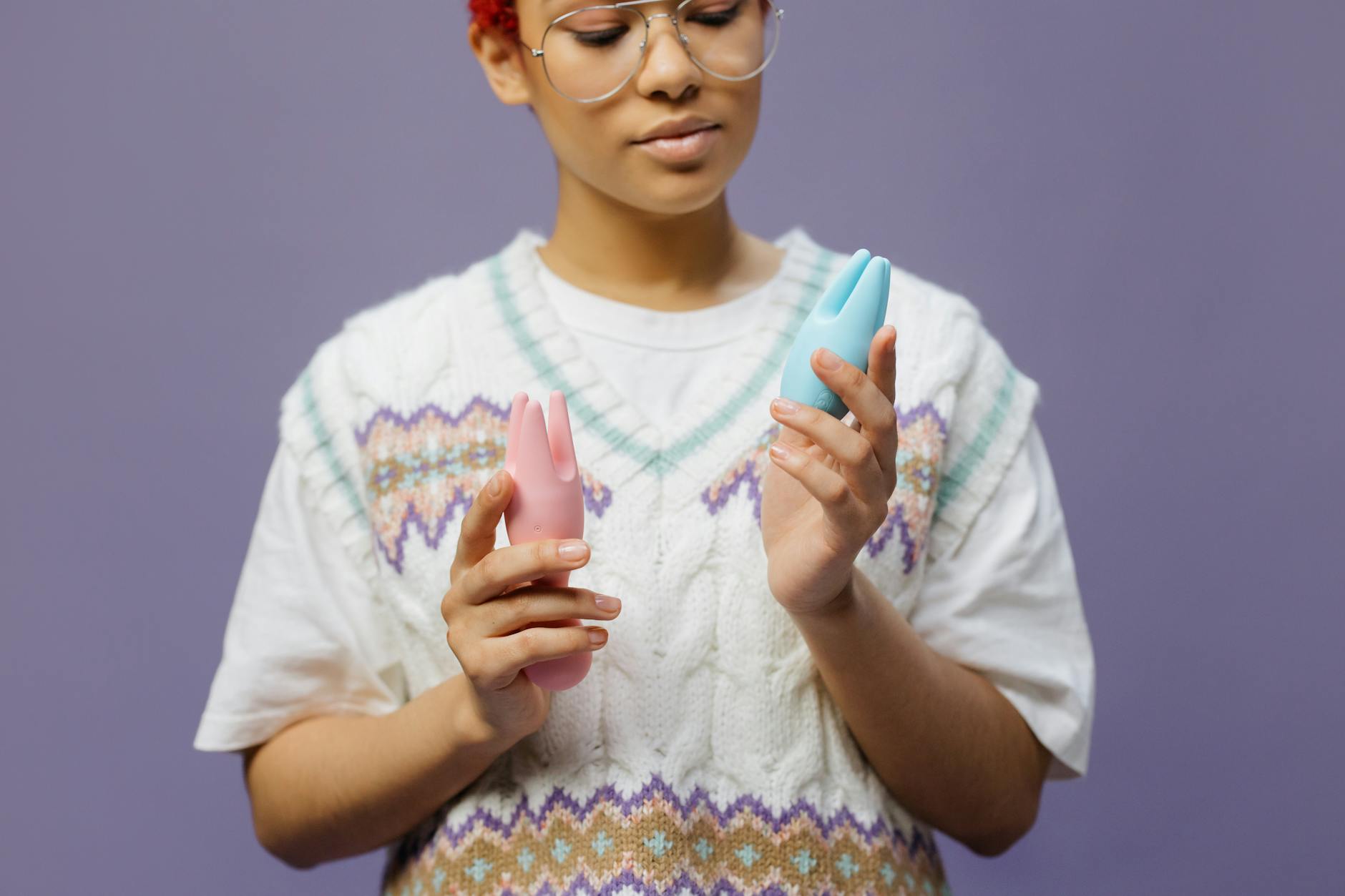
Here's what's actually happening
You've been using your lemon vibrator for months, maybe years. At first, the sensation was electric. Now? It feels like you're touching someone else's body. The vibration barely registers. You turn up the intensity, but it still feels muted, distant, like you're chasing an orgasm that's slowly moving further away.
This isn't dysfunction. This is desensitization. And the good news is that it's completely reversible.
Why frequent vibration causes numbness
Your clitoris has about 8,000 nerve endings concentrated in a space smaller than a pea. When you use the same stimulus at the same intensity repeatedly, those nerves stop firing with the same urgency. This is called accommodation. Your nervous system is literally adapting to the input by tuning it out.
Think of it like wearing the same perfume every day. After a week, you stop noticing it even though everyone else can smell it clearly. Your sensory system has decided: this stimulus is normal background noise, not a threat, not interesting. Stop wasting energy on it.
The more frequently you use a vibrator at high intensity, the faster this happens. Daily use at setting 5 will numb you faster than twice-weekly use at setting 2. It's not about willpower or sexuality. It's neurology.
The reset protocol that actually works
Full sensitivity recovery takes 2-4 weeks if you commit fully. Partial recovery starts in days.
Week one: total vibrator break. I know, it feels impossible. But your nerve endings need to remember what baseline feels like. Use your hands only. Solo exploration with no device. This sounds boring, but it's the accelerant for everything that comes next. Your nervous system will start recalibrating immediately.
Week two: reintroduce touch, very low intensity. If you're going to use a lemon vibrator again, start at pattern 1. Not pattern 2 or 3 where you used to live. Pattern 1 should feel almost silly, like barely anything. That's the point. You're teaching your nerve endings that subtle stimulation matters again.
Limit sessions to 10 minutes maximum. Stop before you feel close to orgasm. This is the hardest part psychologically because your brain expects the payoff. But stopping early forces your nervous system to stay engaged rather than sliding into accommodation.
Introduce variety immediately. Don't use the same vibrator at the same setting every time. Rotate between the lemon vibrator one day, your hands the next day, maybe a wand on a different day. Different textures, different patterns, different intensities. Variety is the antidote to accommodation.
Why the lemon vibrator specifically works better for recovery
Most traditional vibrators use consistent frequency. On setting 3, they vibrate at the same speed indefinitely. This is exactly what creates desensitization because your nerves adapt to predictable input.
The lemon vibrator uses air-suction technology with a variable pulse pattern. The sensation changes subtly even within a single pattern, which means your nerve endings stay engaged. You're less likely to accommodate to it because there's slight variation baked into the stimulus itself.
For someone recovering from numbness, this matters. You can use it more safely without re-numbing yourself as quickly.
Rebuilding the intensity curve
After two weeks of low intensity and variety, you can start gradually increasing. But here's the critical part: increase slowly and with intention.
If you jumped straight back to your old intensity, you'd be right back where you started in two weeks. Instead, think of it as a 4-week ramp.
Weeks 3-4: Alternate between patterns 1 and 2. Never jump to 3. Sessions still 10-15 minutes maximum. Use the lemon vibrator maybe 3 times a week, not daily.
Weeks 5-6: You can introduce pattern 3 occasionally, but keep most sessions at 2. You're building a sustainable ceiling, not chasing the highest number.
Beyond week 6: You can use higher patterns, but spacing matters. If you use the lemon vibrator daily at high intensity, you'll be numb again in 2 months. If you use it 3-4 times a week and vary the intensity, you'll maintain sensitivity indefinitely.
The psychology that sabotages recovery
The hardest part of resetting sensitivity isn't the vibrator. It's your brain.
Your brain has learned a association: lemon vibrator equals orgasm. When you use it at low intensity with the intention to stop before climax, your brain experiences that as a tease. It creates frustration. After a week of this, most people say "This isn't working" and crank it back to high intensity out of sheer irritation.
That's the trap. You have to reframe what using the vibrator means.
For the first 2-3 weeks, the goal isn't orgasm. The goal is feeling. Can you notice the subtle difference between pattern 1 and pattern 2? Can you feel the edges of your clitoral hood more clearly when you use less pressure? Are you noticing sensations you'd forgotten existed?
Orgasm will come back. But right now, your only job is to restore the capacity to feel.
When to use hands instead
Handwork is not a consolation prize during recovery. It's often superior because you have real-time feedback and control that vibrators can't match.
With your hands, you can vary pressure moment by moment. You can tease. You can slow down and speed up based on what your body is telling you. A vibrator can't do that. A vibrator does one thing at one intensity unless you change the setting.
During recovery weeks, hand exploration should be your primary tool. Use the lemon vibrator maybe once or twice a week, low intensity, short duration. Let hands do the heavy lifting.
Many people find they enjoy the sensations more with hands during this period because they're so much more responsive. There's actual foreplay texture to it instead of constant stimulation.
The partner conversation
If you share solo time with a partner, this matters. They might misinterpret "I'm using the vibrator less" as a lack of desire for them. That's not what's happening.
You're not less interested in sex. You're resetting your nervous system. Say that directly. "I got a bit numb using vibrators daily, so I'm taking a break to rebuild sensitivity. It has nothing to do with how I feel about you." Most partners get it immediately.
If you use the lemon vibrator together, they also benefit from you being more responsive. Numb tissues aren't fun for anyone. Sensitive tissues that can actually feel their touch? Much better.
Maintenance after recovery
Once you've rebuilt sensitivity, you want to keep it. That means preventing the same accommodation pattern.
Use the lemon vibrator 2-4 times per week maximum, not daily. Vary the intensity across sessions. Spend maybe half your solo time with vibrators and half with hands or other stimulation. Take occasional breaks, like one week off every two months.
This isn't deprivation. This is how you keep sensation alive long-term. People who use the vibrator once a week maintain sensitivity for years. People who use it daily every day eventually plateau again.
You're not broken. You just need a smarter rhythm.
FAQ: Sensation recovery and clitoral vibrators
How long does it really take to feel sensation again? Most people notice subtle improvement within 3-5 days of breaking and usually within one week. Full recovery to baseline sensitivity takes 2-4 weeks if you're committed. If you slip back to high intensity during week two, the clock resets.
Can I still use the lemon vibrator during recovery? Yes, but only at the lowest settings for short durations. Think of it as testing, not your main tool. Hands and other touch should be primary during weeks 1-3.
Will my sensitivity ever come back to the very first time I used a vibrator? Almost never, and that's actually fine. Your first time was also novelty. You don't need to recreate that exact feeling. You need to feel present sensation clearly, and that definitely comes back with reset.
What if I use multiple lemon vibrators or devices? Same rule applies. The issue isn't the device. It's frequency and intensity. You could feel numb from any vibrator used daily at high intensity.
Is this normal? Very. It's one of the most common issues I hear from people who use clitoral vibrators regularly. You're not weird, broken, or overstimulated in the clinical sense. You're just experiencing predictable neurology.
Can I prevent this from happening again? Yes, absolutely. Vary your tools. Take breaks. Keep intensity moderate most of the time. If you notice sensation starting to drift, take a week completely off instead of waiting until you're fully numb.
Does the lemon vibrator's air-suction technology really prevent numbness better than other vibrators? The variable pulse pattern does seem to reduce accommodation risk compared to steady-frequency vibration. But any vibrator used daily at high intensity can eventually numb you. The technology helps, but rhythm matters more.
The reset is real
You haven't lost your capacity for pleasure. Your nerves just need a break and a smarter pattern going forward. Two to four weeks from now, you'll feel things in your body that you'd forgotten existed. The lemon vibrator will feel new again. Not like your first time, but genuinely present.
Start the break today. Your sensation will thank you.
If you have questions about rebuilding pleasure after numbness or want to explore a customized approach for your body, we're here to talk. Get in touch with Lemon Vibrator.
Sources
Kaufman, J. M., et al. (2005). Erectile dysfunction. The Journal of Sexual Medicine, 2(3), 266-290. Studies on sensory accommodation and nerve adaptation.
Meston, C. M., & Frohlich, P. F. (2000). The neurobiology of sexual function. Archives of General Psychiatry, 57(11), 1012-1030. Research on clitoral sensitivity and desensitization patterns.
Cipres, D., et al. (2016). Genital sensation and sexual function in women with and without provoked vestibulodynia. Journal of Sexual Medicine, 13(6), 865-874. Evidence on tactile sensitivity variation and accommodation.
Goldstein, I. (2000). Female sexual arousal disorder: new insights. International Journal of Impotence Research, 12(S4), S152-S157. Clinical observations on sensory thresholds and vibration response.